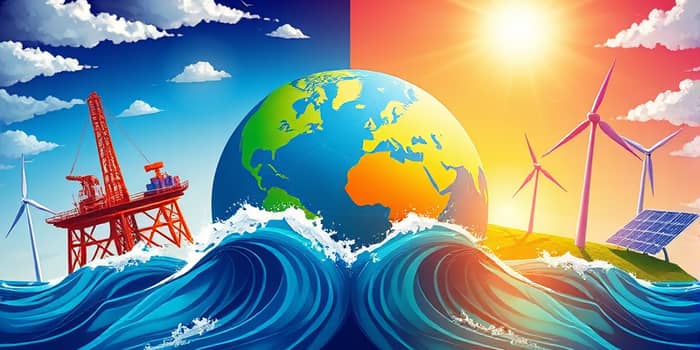
In a world shaped by shifting power dynamics, energy markets stand at the crossroads between a legacy of oil dominance and the promise of clean power. This article traces the arc from OPEC’s historic influence through the latest renewable revolution, offering insights and practical guidance for policymakers, investors, and citizens alike.
Since its founding in 1960, OPEC has been a central actor in global oil markets. By managing crude output, its member nations have wielded supply cuts and expansions to support sovereign revenues and influence prices worldwide.
As of June 2025, OPEC’s collective production reached 30.34 million barrels per day, up nearly 5% year-on-year. Saudi Arabia, the group’s largest contributor, pumped 10 million barrels daily in October 2025, while Iran’s output dipped due to internal constraints. The alliance extended output cuts first enacted in November 2022 through 2026 to stabilize prices amidst demand uncertainties, balancing supply against growing non-OPEC competition.
Beyond OPEC’s 13 members, the broader OPEC+ coalition includes major non-OPEC producers like Russia. Together, they calibrated further cuts as U.S. shale lifted global output, keeping world crude supply roughly flat in 2024.
Despite disciplined production, OPEC’s export revenues are forecast to slip from $455 billion in 2025 to $410 billion in 2026 (unadjusted for inflation), reflecting moderate prices near $65.79 per barrel for Brent and $61.79 for WTI.
Energy policies can shift rapidly. The U.S. Inflation Reduction Act, for instance, reshaped incentives for both fossil and renewable investments, while its potential dismantling looms large for global capital flows.
Geopolitical tensions—from trade disputes to supply-risk concerns—spur the diversification of energy sources for security. European and Asian importers especially seek resilience against disruptions in oil and gas deliveries.
Global power demand continues its steady ascent, driven by data centers in developed markets and by industrial and building growth in emerging economies. According to leading scenarios, renewables (wind and solar) will supply more than 50% of global electricity by 2050, while their share of primary energy will range between 12% and 41%.
China leads this transformation, dominating in both deployment and manufacturing of clean energy technologies. India follows suit with surging investments in solar, wind, and grid infrastructure. Together, they anchor a shift powered as much by industrial competitiveness and job creation as by climate goals.
Across continents, energy trajectories diverge. China pushes full steam ahead on electrification, while the U.S. and EU navigate policy volatility amid rising data center loads. India accelerates renewable projects, and Africa and the Middle East project growth in both oil and electricity demand through 2035. OECD nations see modest oil declines offset by technology-driven energy services.
While coal faces a 28%–93% decline by 2050 compared to 2023 levels, oil and gas present mixed futures, hinging on regional policy choices and climate ambition. Liquified natural gas demand in Europe may wane, even as China’s appetite depends on its transition speed.
Beyond turbines and panels, the energy landscape will be reshaped by AI, digital twins, and advanced grid management systems. Clean firm power—nuclear, geothermal, hydropower—will back up variable supplies, while storage technologies expand.
The journey from OPEC’s oil hegemony to a renewables-dominated era is neither linear nor certain. Yet, the numbers tell a compelling story: 105.1 million barrels per day of oil demand in 2025, over $2 trillion annual clean energy investment, and a world where more than half of electricity comes from wind and solar by mid-century.
Success will depend on sustained policy support, resilient supply chains, and the ingenuity to marry digital innovations with physical infrastructure. For stakeholders at every level, the imperative is clear: embrace change, seize opportunities, and ensure that the transition not only cuts carbon but delivers secure, affordable power for all.
References