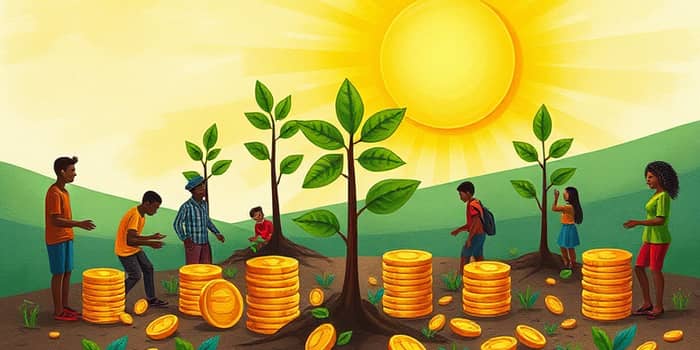
In a world where economic uncertainty pervades daily life, individuals hold more power than ever to shape the future through financial decisions. From writing a plan to choosing where to invest, each choice reverberates across communities and ecosystems. This guide explores how to turn personal finance into a force for positive change.
Personal finance forms the bedrock upon which impact becomes possible. Yet, 36% of Americans have a written financial plan, leaving a majority without clear direction. Daily money worries afflict 60% of people, and one in three carry more credit card debt than savings. For young adults, the stakes feel even higher: 55% of Gen Z and 49% of Millennials lack sufficient emergency funds to cover three months of expenses.
Despite these challenges, 72% of Gen Z took steps to improve their financial health in 2025. They focused on savings (51%) and debt repayment (24%), demonstrating a shift toward proactive management. Building a sustainable future always begins with building a resilient financial foundation.
Low-income families face even steeper hurdles: households earning below $30,000 per year report that 41% see their financial life as "worse than expected," up from 33% in 2022. This economic stress compounds problems, reducing access to affordable credit and financial advice. Yet, learning basic budgeting and automatic savings can bridge gaps and empower households to build resilience.
Beyond personal budgets lies the domain of impact investing, where money seeks to yield financial returns and social good. This field has witnessed explosive growth: from $129 billion in assets under management in 2019 to over $1.5 trillion by late 2025. Global investors now allocate capital across energy, healthcare, agriculture, and financial services, with 21% in finance and 20% in energy.
Impact investing differs from ESG strategies by targeting measurable social and environmental benefits. It demands transparent data on outcomes like reduced carbon emissions or improved income equality. Private equity leads this surge, jumping from $15.2 billion to $79.5 billion in six years, while Community Development Financial Institutions in the U.S. grew assets by 615% since 2014, reaching $458 billion in 2023.
Market projections remain optimistic: analysts estimate that the global impact market could double again by 2035, driven by a rising cohort of values-driven investors and a tightening regulatory environment. Sectors like renewable energy and social housing are poised to attract the lion’s share of new capital, reflecting urgent needs and growth potential.
The shift to impact is also driven by regulatory interest. Governments and international bodies now encourage transparency through reporting standards, requiring firms to disclose measurable progress on issues like carbon neutrality or social equity. Such frameworks bolster trust, allowing investors to compare outcomes across funds and regions, and creating a virtuous cycle of improved data and accountability.
Once your fundamentals are in place, consider aligning investments with your core principles. Start by auditing your current portfolio for funds or accounts that may conflict with your ethics—such as carbon-intensive industries or questionable labor practices.
Measuring impact remains critical. Seek out funds that report against recognized frameworks such as the GIIN IRIS+ metrics or the UN Sustainable Development Goals. This ensures that sustainable investing is increasingly mainstream, and that your capital supports verifiable progress rather than vague promises.
By taking these steps, you ensure capital works both for you and for broader societal goals. Remember, capital can be a force for good when applied thoughtfully.
Concrete case studies illustrate how strategic finance drives transformation. The Rockefeller Foundation supports initiatives like the Disability Opportunity Fund, which provides affordable housing and job training for people with disabilities. In Australia, the NAB Foundation launched a $50 million Impact Investment Fund targeting indigenous advancement and climate resilience. Such examples show that funds can deliver returns while uplifting communities and protecting our planet.
Consider local grassroots initiatives too. In Latin America, a microfinance project in rural Ecuador offered small loans to cacao farmers, boosting incomes by 30% and promoting sustainable agroforestry. Such targeted interventions show that well-deployed capital can generate measurable change in lives and landscapes.
These stories underscore the importance of measurable outcomes and transparent reporting, driving accountability and learning across the sector.
Looking ahead, the sustainable finance landscape will continue evolving. Experts forecast a global impact investing market of up to $1.27 trillion by 2029, fueled by a 19.4% CAGR. Meanwhile, trade policies around sustainability reporting software and tariffs may reshape how impact is measured internationally.
On the cultural front, social media platforms have democratized financial education, fostering open conversations about money. Sixty-six percent of Gen Z report feeling no pressure to overspend, highlighting a shift toward mindful consumption. This transparency is critical: for the first time, personal finance and impact investing discussions occur in tandem, empowering more people to participate in driving change.
Creators now share budgeting challenges and ethical investing journeys, demystifying complex topics. Fintech apps overlay impact scores on traditional portfolio managers, giving real-time feedback on the positive outputs of each dollar invested. These tools make it easier than ever to balance returns with purpose.
Financial stress lowers productivity and morale, affecting personal well-being and workplace performance. By embracing financial literacy and values-driven investing, individuals can alleviate stress while contributing to global solutions.
Every dollar you earn, save, or invest carries an opportunity to influence lives and ecosystems. Whether you begin with a simple budget, explore CDFIs, or commit to full-scale impact portfolios, the choices you make ripple outward.
Ask yourself: Does my emergency fund reflect my ethics? Could my next investment underwrite renewable energy or affordable housing? How can I amplify my voice through community projects? By engaging your curiosity and taking incremental steps, you transform financial decisions into purposeful action.
Envision an investment portfolio that not only grows wealth but also funds community centers, restores ecosystems, and advances health equity. By continuously educating yourself and adjusting allocations, you become part of a global movement demanding more from capital. Remember, the tension between risk and reward need not compromise ethics; it can fuel innovation and unlock new opportunities.
The intersection of personal finance and impact investing marks a new era where individual choices can rebuild societies and restore natural systems. Join the millions shaping a fairer, greener world—your money, your impact, starts now.
References