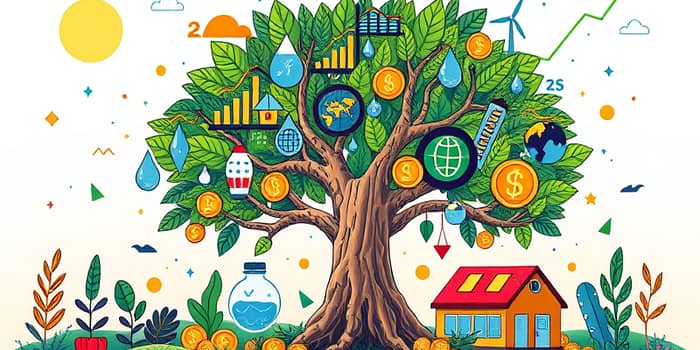
In an era defined by climate urgency and social change, investors are reimagining wealth. Traditional metrics of success no longer suffice—today’s portfolios must deliver both robust returns and positive impact. This comprehensive guide explores how to build sustainable wealth that endures.
Integration of environmental, social, and governance criteria transforms investing from profit-only pursuits into purpose-driven strategies. Under the umbrella of sustainable wealth management, ESG factors become integral in evaluating risks, opportunities, and long-term value.
Impact investing further elevates this approach by focusing on measurable social and environmental benefits. Whether backing renewable energy projects, supporting affordable housing, or advancing diversity and inclusion, impact investments align capital with real-world outcomes.
The sustainable finance sector has witnessed explosive expansion. As of December 2024, sustainable mandates exceeded £11bn in the UK alone—a remarkable 375% rise since 2018. In the US, 79% of market assets ($41.5 trillion) now operate under stewardship policies, reflecting institutional commitment.
Client appetite is mirrored by performance. In H1 2025, the median return of sustainable funds reached 12.5%, outpacing traditional funds at 9.2%. Morgan Stanley’s Investing with Impact Platform manages nearly $77 billion, underscoring strong adoption among high-net-worth individuals.
Effective sustainable portfolios combine multiple tactics to balance risk, return, and purpose. Four core strategies dominate the landscape:
Personalization remains a growing frontier. Investors can now tailor themes—climate action, gender equity, faith-based values—to reflect individual convictions and deliver targeted impact.
Robust regulation underpins trust. The EU’s Sustainable Finance Disclosure Regulation (SFDR) enforces rigorous ESG classification, curbing greenwashing by demanding substantiated claims and detailed disclosures. Complementing SFDR, the EU Green Taxonomy offers a science-based standard defining environmentally sustainable activities, guiding capital toward genuine impact opportunities.
Globally, regulators are harmonizing standards, enhancing data security, and scrutinizing digital asset custody, all in service of greater transparency. Wealth managers must stay agile to navigate evolving compliance demands.
Diversification is paramount in building resilience. Optimal portfolios blend listed equities, fixed income, private debt, infrastructure, and alternative assets to balance risk, return, and impact. Manager selection hinges on climate risk integration and stewardship quality, ensuring alignment with the Paris Agreement.
Evidence of outperformance has attracted broader interest. Institutional investors are increasingly convinced that sustainable funds do not sacrifice returns in pursuit of impact—they often enhance them.
Millennials and Gen Z are redefining wealth stewardship. Three in five younger family members expect their wealth managers to provide innovative solutions for environmental challenges, driving a wave of demand for purpose-aligned offerings. Family offices, managing average assets of $1.1 billion, now prioritize impact investing as a cornerstone of intergenerational legacy planning.
Despite momentum, hurdles remain. Greenwashing concerns persist, compelling regulators to tighten disclosure requirements. The patchwork of global regulations introduces uncertainty, particularly where US rollbacks contrast with EU advances. Data scarcity further complicates accurate measurement of impact, spurring a push for more granular, verifiable ESG datasets.
Looking ahead, sustainable assets under management are projected to grow at a 5.4% annual rate through 2028, fueled by mass-affluent interest. Impact investments are poised not only to deliver alpha but also to drive progress on the UN Sustainable Development Goals, especially in clean energy and climate action. Digital transformation—tokenization and tech-enabled reporting—will further democratize access to sustainable opportunities.
In building a portfolio you tribun, focus on enduring principles: rigorous ESG integration, diligent stewardship, and purposeful asset allocation. By embracing innovation, leveraging data-driven tools, and aligning with client values, wealth managers can craft portfolios that generate long-term financial return alongside positive impact. This is sustainable wealth—a legacy for investors and society alike.
References