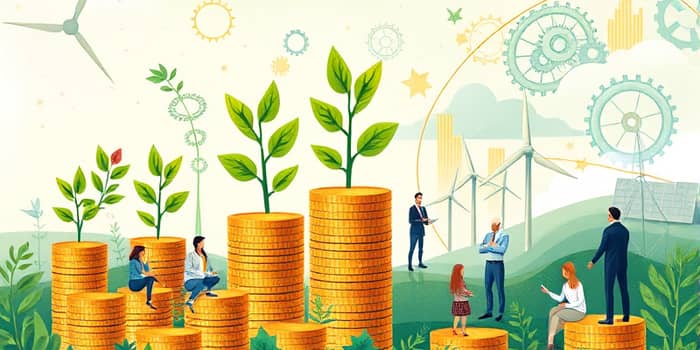
Investing has evolved beyond pure financial metrics to embrace principles of purpose and impact. Today’s investors seek more than profits—they demand portfolios that reflect their values and contribute meaningfully to society. This shift has given rise to a dynamic approach known as ESG investing, which evaluates companies by their environmental, social, and governance performance.
ESG stands for Environmental, Social, and Governance factors, a framework that assesses a company’s non-financial risks and opportunities.
Also called sustainable investing or responsible investing, ESG incorporates metrics such as carbon footprint, waste management, diversity and inclusion, and executive pay when making investment decisions. This holistic evaluation identifies businesses that balance profit with planet and people considerations.
The global ESG investing market has reached impressive scale. As of June 2025, sustainable funds held $3.5 trillion in assets, up 10% from the prior quarter. Broader estimates place the total market at $39.08 trillion in 2025, with projections soaring to $125.17 trillion by 2032—a remarkable 18.1% compound annual growth rate.
Regionally, Europe leads with ESG representing 19% of its open-end fund universe, compared to just 1% in the US. Despite short-term outflows—$8.6 billion globally in Q1 2025—fund inflows rebounded with $8.6 billion new money in Q2, underscoring durable investor appetite.
Data consistently show an ESG advantage in performance. Sustainable funds generated median returns of 12.5% in the first half of 2025, outpacing 9.2% for traditional funds—the strongest outperformance since 2019.
These figures underscore that integrating ESG can be a catalyst for both growth and resilience, debunking myths that purpose-driven investing sacrifices returns.
ESG investing delivers multiple strategic benefits, making it a compelling choice for discerning investors.
Investing in renewable energy supports SDG 7 (Affordable and Clean Energy), while diversity initiatives drive SDGs 5 and 10 (Gender Equality and Reduced Inequalities). By aligning portfolios with the UN Sustainable Development Goals, investors amplify global impact.
Despite strong momentum, ESG investing faces hurdles. In the US, political backlash and regulatory shifts have led to 11 consecutive quarters of net outflows. Concerns about greenwashing risks have prompted stricter labeling rules in Europe, while the absence of universal standards complicates cross-border comparisons.
Data quality and inconsistent corporate disclosures further challenge investors seeking reliable ESG metrics. Addressing these gaps will require standardized reporting frameworks and enhanced regulatory oversight.
Looking ahead, ESG investing is poised to become mainstream. Seventy-three percent of US SIF respondents predict significant market growth in the next 1–2 years, driven by client demand and regulatory mandates.
Institutional investors and private fund managers are developing sophisticated approaches to navigate evolving rules across regions. Enhancing transparency, leveraging advanced analytics, and integrating ESG into core investment processes will define the next wave of growth.
Europe remains the engine of global ESG momentum, hosting 85% of sustainable fund assets, but markets in Asia and Latin America are awakening to the potential of impact-driven strategies.
For individual investors, ESG offers a way to align portfolios with personal values while pursuing competitive returns. Consider funds with clear ESG screens, robust engagement policies, and third-party verification to mitigate greenwashing concerns.
Businesses can embrace ESG as a source of strategic advantage. By embedding sustainability into core operations, firms enhance resilience, attract capital, and strengthen stakeholder trust. Executives should prioritize transparent reporting, set ambitious targets, and engage investors proactively.
The ESG advantage is more than a buzzword—it’s a powerful investment philosophy that unites financial performance with global purpose. With assets exceeding $3.5 trillion, proven outperformance, and compelling benefits across risk management, innovation, and reputation, ESG investing is transforming the investment landscape.
As markets evolve and regulatory standards mature, investors and companies that embrace environmental, social, and governance principles will unlock sustainable growth and lasting impact. The time to harness the ESG advantage is now.
References